
The next one goes red. You hold it. Minus 0.5R becomes minus 1R becomes minus 2R. You finally cut it, late, annoyed, and confused about why you just did the exact opposite of what you promised yourself fifteen minutes ago.
Selling winners early and holding losers is not a discipline failure. It is a pattern with a name, a mechanism, and a decades-long research trail behind it. Once you see how it works, you stop blaming yourself and start building around it.
Traders cut winners short and ride losers into the ground. It happens so reliably that researchers gave it a name: the disposition effect. It shows up in retail accounts, on institutional desks, and in lab settings where people trade with fake money and have nothing at stake but pride.
The shape is usually the same. Green position, grab the gain. Red position, hold and wait for a bounce that may never come. The net result is an account full of small wins and a handful of losses big enough to erase them.
Most traders assume this is a willpower problem. It is better understood as a wiring problem, and it likely draws on the same machinery behind the trade you take ten minutes after a loss.
What the research actually found
Hersh Shefrin and Meir Statman named the pattern in 1985. Terrance Odean then went and measured it: a 1998 study of roughly 10,000 individual brokerage accounts over seven years, comparing the proportion of gains realised against the proportion of losses realised. Investors were significantly more likely to sell a winner than a loser. Not by a rounding error. By a lot.
The early selling was not strategy. The investors in the study were not running a calculated tax-loss playbook. They were doing what felt right in the moment, and what felt right was often the costly move.
The reason traces to how the mind stores gains and losses. Daniel Kahneman and Amos Tversky's prospect theory (1979) showed that people do not evaluate outcomes on an absolute scale. They evaluate them against a reference point, usually whatever they paid. And gains and losses are not encoded symmetrically: a loss from that reference point does not feel like the mirror image of an equivalent gain. It occupies a different category entirely.
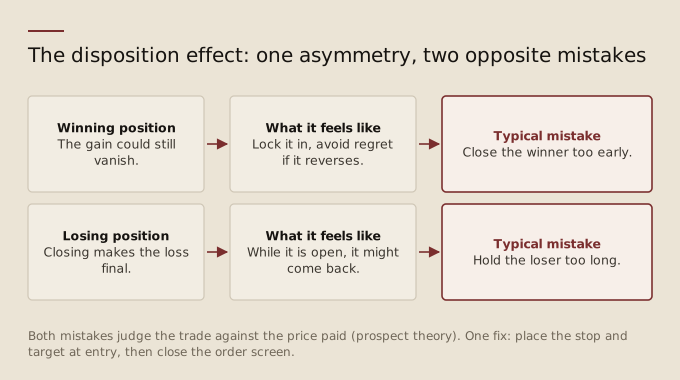
So when you are sitting on a winner, you are holding something you could lose. The gain is real right now. If you hold, it might vanish. Your mind says: lock it in, take the certainty, avoid the regret of watching it reverse.
When you are sitting on a loser, closing the trade makes the loss permanent. Final. Your mind would rather sit in the discomfort of an open position than accept that sharp, irreversible version of it. Because as long as the trade is open, there is still a chance it comes back. Hope is an anaesthetic.
What it looks like in a real session
You take two trades in the morning. Trade A hits plus 1R quickly and you close it. Trade B goes against you by minus 0.5R and you hold, waiting for a pullback. By lunch, Trade A has run to plus 3R without you, and Trade B has widened to minus 1.5R before you finally close it.
Net: minus 0.5R. But the money is not the damage. The damage is the story you build afterwards. "I need more discipline." "I need to let winners run." "I need to stop being emotional."
None of those conclusions is wrong exactly. It just misses the mechanism. You cut the winner because your mind was protecting a gain it did not want to lose. You held the loser because your mind was avoiding a pain it did not want to feel. Both decisions came from the same asymmetry. No amount of journaling "let winners run" overrides an asymmetry through willpower.
Why it hits some traders harder
Not every trader experiences this the same way, and that is the part most articles skip.
TIP's Full Assessment asks about a disposition effect axis directly, alongside conviction, patience and discipline, and scores how you describe each. These are not the same dial. A trader high on patience tends to tolerate the discomfort of an open position longer, whether that position is winning or losing, which helps them hold winners and hurts them holding losers. A trader low on patience tends to act fast, which cuts losers cleanly and clips winners early. Same research finding. Opposite behaviour at the charts.
The point is not that one profile is better. It is that the disposition effect can express differently depending on the profile underneath, so the fix has to match it. A trader whose pain-per-tick runs high may do better with wider stops and smaller size, so the discomfort stays under their threshold. A low-patience trader may do better with bracket orders that remove the exit decision entirely. Same problem on the surface. Completely different solution underneath.
Profile differences are why advice copied from a trader whose profile is nothing like yours often does not hold. It was not built for you.
Which version of this is yours?
The disposition effect does not hit every trader the same way. The Free Trader Profile scores how you describe the risk dispositions this post is about, names your closest archetype, and names the failure mode worth checking. No account, no card.
Get My Free Trader Profile →Go further with the Full TIP Report. Complete the free Full Assessment to unlock your personalised report: 40+ pages connecting your self-reported patterns with questions to check against your trading records. $79 one-time, with a 14-day money-back guarantee. Start your profile and explore the full report →
Receive Field Notes by email. At the end of your free profile, save your result by email and select the separate, optional Field Notes checkbox. Unsubscribe anytime. Get your profile and choose email updates →
The traders who beat it do not try harder
Traders who beat the disposition effect remove the exit decision from the moment.
Hard stops placed at entry and never touched. Bracket orders that automate both the stop and the target. A personal rule like "if I would not take this trade fresh right now, I close it," applied mechanically rather than negotiated. Anything that takes the exit away from the part of your mind that is managing pain instead of managing the trade.
Session design is the second tool. Many traders find their decision quality slips across a session, and the disposition effect tends to get worse as they tire. Knowing the point in a session where your decisions start breaking down, and stopping before you reach it, is not weakness. It is design.
Try this before your next session
Write down the specific R-multiple where you will exit each trade, both stop and target. Place both orders the moment you enter. Then close your order management screen. Not minimise it. Close it. Remove the visual trigger that invites you to intervene.
Do that for five consecutive trades and you will have more evidence about the disposition effect in your own trading than most traders accumulate in a year of journaling.
Your disposition is not a character flaw. It is a pattern with a well-documented shape in the research, and your own trade records will show how it plays out for you.
Odean, T. (1998). Are investors reluctant to realize their losses? The Journal of Finance, 53(5), 1775 to 1798.
Kahneman, D., & Tversky, A. (1979). Prospect theory: An analysis of decision under risk. Econometrica, 47(2), 263 to 292.
The researchers cited here are not affiliated with TIP and do not endorse it. We cite their published findings; the application is our own.