
IQ is the wrong measure for traders because one score blends abilities that can be strong and weak in the same person. Trading draws on several at once: pattern recognition, chart vision, working memory, decision speed, risk and sizing math, and market knowledge. Two traders with the same IQ can fail for opposite reasons, so look at each ability separately.
Picture a prop-firm trader who can solve logic puzzles faster than anyone on the floor, aces every cognitive test HR has thrown at him, and struggles to hold three moving parts in his head during a fast session. He misses stops because by the time price gets there, he has lost track of where he put them.
Across the same room sits a trader who could not tell you what her IQ is and has never once thought about IQ, who reads price action faster than anyone in the firm, and who has been consistently profitable for eight years.
The two traders look less like two levels of the same kind of smart and more like different abilities. If you are using intelligence as a single dial to explain why some traders work and others do not, you are holding the wrong instrument.
The single-score problem
General IQ is a score. It collapses a dozen distinct abilities into one number and hands it to you as though it means something actionable. For a lot of jobs, it sort of does. For trading, it hides most of what you would want to know.
A trader with strong chart vision and a weaker working memory may have a different edge and a different vulnerability than a trader with the opposite profile. The score cannot show either. Two people with identical numbers can be profitable in radically different ways, or unprofitable for radically different reasons, and the number cannot tell them apart.
The problem is not that IQ tests measure badly. The problem is that trading asks the mind to do several separable things at once, and collapsing them into one figure hides information you could have used.
What Carroll found
John Carroll spent most of a career on the question of separate abilities. In 1993 he published a reanalysis of more than 460 factor-analytic datasets, one of the largest syntheses of cognitive ability research ever produced. The book is Human Cognitive Abilities, and it is dense enough that most psychologists just call it "the Carroll book."
Carroll built on Raymond Cattell and John Horn, who split intelligence into fluid and crystallized components: reasoning through novel problems in real time, versus the accumulated knowledge you have built from experience. Cattell and Horn established that these move somewhat independently. Carroll extended it into a full taxonomy of broad abilities, each measurably distinct. Kevin McGrew synthesised the modern version in 2009, and the result is called CHC after its three architects. It is the dominant taxonomy in contemporary cognitive assessment.
The finding that matters for traders: these abilities are separable. You can sit in the 90th percentile on one and the 30th on another. They do not move as a package.
The six that matter at the charts
The six below are TIP's own trading-specific labels. They are named after the CHC idea that abilities are separable, not taken from a CHC test, and TIP does not test them: it scores how you describe each one. They are a way to organize the question, not a measurement of your brain.
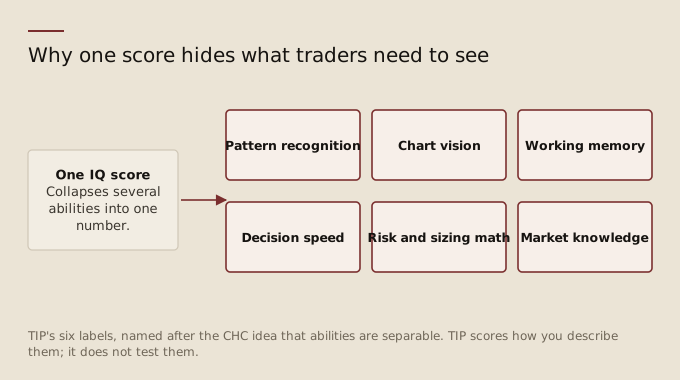
Pattern recognition lets you see a setup forming before the setup completes. Stronger here, you may catch things early. Weaker here, a setup may need to be closer to complete before it registers.
Chart vision is reading structure at a glance: support, resistance, the shape of a consolidation, the geometry of a base. Separate from pattern recognition. One is inferential, the other is perceptual.
Working memory is how many moving parts you hold without writing them down. Entry, stop, target, size, context, correlation, session time, macro backdrop. If you rate yourself lower here, start by testing tools that hold the load for you: a written checklist, alerts, orders staged in advance.
Decision speed is the time from seeing a trigger to acting. It tends to matter more the shorter the holding period. A self-rating here is a place to start checking your own entries, not a verdict on which methods you can trade.
Risk and sizing math is R-multiples, expectancy, position-level probability. Every decision is implicitly a math problem whether you treat it as one or not; without this, it gets solved by feel.
Market knowledge is the accumulated setup library, instrument behaviour, macro memory. The only one on this list that compounds purely with time and attention.
The six abilities need not travel together. Strong chart reading with a weak grip on many moving parts is an easy profile to recognize in practice. So is sharp risk math with unremarkable pattern recognition. The combinations matter more than any single number, which is exactly what a single number cannot show you, and it is the combination that produces what you would call a trader type.
Which of the six do you lean on?
The combinations matter more than any single number, and they are hard to see from the inside. The Free Trader Profile scores how you describe the six abilities in this post and names the closest archetype they add up to, a hypothesis to check against your own trading. Two minutes, no account, no card.
Get My Free Trader Profile →Go further with the Full TIP Report. Complete the free Full Assessment to unlock your personalised report: 40+ pages connecting your self-reported patterns with questions to check against your trading records. $79 one-time, with a 14-day money-back guarantee. Start your profile and explore the full report →
Receive Field Notes by email. At the end of your free profile, save your result by email and select the separate, optional Field Notes checkbox. Unsubscribe anytime. Get your profile and choose email updates →
Why this is practical, not academic
Most traders who hit a wall blame discipline, or emotions, or mindset. Sometimes that is right. Often the bottleneck is an ability they have never looked at directly and have no language for.
Take a trader who rates his working memory lower and scalps four instruments at once. The problem may not be discipline. The method may ask him to hold more than he reliably can in the moment. Before deciding anything about which method suits him, he can check his records for where the slips happen, and test scaffolding that carries the load: checklists, alerts, orders staged in advance. Skills and routines can develop. A self-rating says where to look, not where his limit is.
A trader with strong pattern recognition but slower decision speed may not be hesitating in any character-flaw sense. Her read may be running ahead of her execution. Mechanical entry rules that shorten the step from read to order are one thing to test, and her own fills will show whether the delay is really there.
Trading education rarely says that traders lean on different abilities. The courses assume everyone has the same apparatus and needs the right strategy. The mindset coaches assume everyone has the same apparatus and needs the right mindset. Both miss that traders differ. And the interesting question was never "am I smart enough to trade." It is: which abilities do I lean on, and what does my own record say about where they help and where they slip?
The traders who last are not the ones with the highest score. They are the ones who worked out which abilities they lean on, checked it against their own records, and built something that fits them.
The rest are running on willpower, until the willpower runs out.
Horn, J. L., & Cattell, R. B. (1966). Refinement and test of the theory of fluid and crystallized general intelligences. Journal of Educational Psychology, 57(5), 253 to 270.
Carroll, J. B. (1993). Human Cognitive Abilities: A Survey of Factor-Analytic Studies. Cambridge University Press.
McGrew, K. S. (2009). CHC theory and the human cognitive abilities project. Intelligence, 37(1), 1 to 10.
The researchers cited here are not affiliated with TIP and do not endorse it. We cite their published findings; the application is our own.