
A trading plan often breaks for one of three reasons. The rule was copied and does not fit how you trade, the rule is right but costs too much attention under pressure, or the rule has no condition in it. Each needs a different fix, and your trade record shows which one applies.
You wrote the plan on Sunday. It was a good plan. You were calm, you had the whole week in front of you, and every rule in it seemed obviously correct.
On Tuesday at 10:14 you did something else.
Then you did the thing everyone does. You wrote the plan again, slightly stricter, with a line at the top in capitals about discipline. And on Thursday, at roughly the same time of day, you did something else again.
The plan was written by someone who was not there
The structural problem with a trading plan is who writes it, and almost nobody names it.
The plan is written by a version of you with no position on, no P&L moving, no clock running, and no gap between where your account is and where you expected it to be. That version is thoughtful, patient, and completely unbothered. That version is also not the person who has to execute it.
The person executing is in a different state entirely. Not a worse person. A different one, running the same machinery under load. Sunday-you writes rules for a trader who does not exist at 10:14 on Tuesday, and then Tuesday-you gets blamed for not being him.
The plan-writer problem is why the standard fix fails so reliably. You rewrite the plan harder. But rewriting is a Sunday activity. You are sending an even more demanding set of instructions to the same operator, under the same load, and expecting a different result.
Three reasons a rule does not hold
The three reasons feel identical from the inside. They are not, and the fix for each is different.
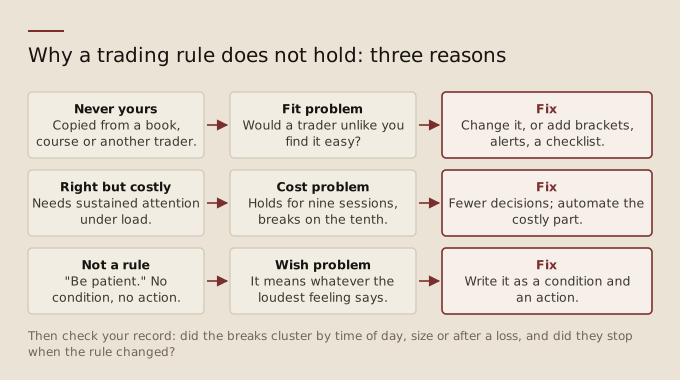
The rule was never yours. You took it from a book, a course, or a trader whose results you admire. It fits them. It may be actively wrong for you.
"Never take a trade in the first fifteen minutes" is excellent advice for someone whose edge is patience and terrible for someone whose entire edge is decision speed at the open. Copying a rule is copying the output of someone else's self-knowledge. What made it work was the fit, and fit does not transfer.
The rule is right but the cost is high. Some rules are correct and take sustained attention. A rule that asks you to override an instinct every time may become harder to follow under pressure. It holds for nine sessions and breaks on the tenth, and the tenth is the one you remember. That is not a character arc. Check when it breaks, then test a support that reduces the effort it needs.
The rule is not actually a rule. "Take good setups." "Do not overtrade." "Be patient."
Rules like these are wishes wearing a rule's clothing. They contain no condition, so at the moment of decision they can mean anything, and whatever feeling is loudest gets to define them. You did not break that rule. It was never load-bearing.
What the research points at
Brad Barber and Terrance Odean spent years on the question of what separates individual investors' results. Across tens of thousands of real brokerage accounts, the investors who traded the most earned the lowest net returns, and the authors linked that to how much people traded and the confidence behind it. A follow-up study found that men traded more than women and paid for it in returns, which the authors read as overconfidence. Same instruments. Same information. Different operators.
The thesis of this note in one sentence: often the instrument is not the problem. The operator is.
Which reframes the plan question completely. If much of the difference between traders lies in the operator rather than the method, then a plan written without reference to which operator is running it is missing a variable that matters a great deal.
Whose plan are you actually running?
A rule holds better when it fits the trader it is asking to constrain. The Free Trader Profile names your closest archetype and the failure mode worth checking, which can be the difference between a rule you keep and one you renegotiate at 10:14 on a Tuesday.
Get My Free Trader Profile →Go further with the Full TIP Report. Complete the free Full Assessment to unlock your personalised report: 40+ pages connecting your self-reported patterns with questions to check against your trading records. $79 one-time, with a 14-day money-back guarantee. Start your profile and explore the full report →
Receive Field Notes by email. At the end of your free profile, save your result by email and select the separate, optional Field Notes checkbox. Unsubscribe anytime. Get your profile and choose email updates →
The test that separates them
Next time you break a rule, do not write "need more discipline." Ask one question instead:
Would a trader who works differently from me have found that rule easy?
If yes, it is probably a fit problem before it is a discipline problem. The rule asks you to do, under load, something that does not come easily to you yet. Change the rule, or build scaffolding so the rule does not depend on you in the moment: brackets placed at entry, alerts instead of watching, a checklist that carries the load your working memory cannot.
If no, and it would have been hard for anyone, then it is probably a cost problem. The rule is correct and it takes a lot to keep, so make it easier to follow while keeping your mandatory risk limits in place. Fewer decisions. Shorter session. Automate the part that costs the most attention.
And if you cannot state the rule as a condition and an action, it was never a rule. Fix that before anything else, because it is the cheapest problem on the list.
Then look at your record. Did the breaks cluster at one time of day, at one size, or after a loss? Did they stop when you changed the rule? The pattern may point to one of these explanations; check it against the record and consider other causes, such as market conditions or a change in your method.
The plan that survives Tuesday
A plan that holds is not a stricter plan. It is a plan built for the operator who will actually be sitting there, with the habits and skills he has today, under the load he will actually be under.
A plan built for the real operator is harder to write, because it requires an honest look at yourself, and some of it is hard to see from the inside. A structured set of questions about your own decision speed and risk dispositions is a start. Your own trade records are the check, because that is where blind spots show up.
But it is the only version that does not need you to become a different person by Tuesday.
Barber, B. M., & Odean, T. (2001). Boys will be boys: Gender, overconfidence, and common stock investment. The Quarterly Journal of Economics, 116(1), 261 to 292.
The researchers cited here are not affiliated with TIP and do not endorse it. We cite their published findings; the application is our own.