
The type of trader you are is best treated as a pattern to check, not a fixed identity. A trading personality test turns your self-description into a candidate pattern, and your decision record then shows whether it holds. A study of 80 day traders found no specific trader personality profile, so start from one question your record can answer.
You finish a trading personality test and recognise yourself in the result. Then comes the useful question: what would you actually look for in your next session?
A self-report profile can organise how you describe your decisions. It cannot, by itself, establish your trading ability, explain a losing month or choose a profitable strategy for you. Treat the result as a candidate pattern to check, with room for evidence that disagrees. A name becomes useful when you can translate it into an observable action.
The rest of this note gives a practical way to turn a profile result into an observable action, including a hypothetical example you can copy without taking any additional trading risk.
Which meaning of trader type do you need?
Several questions hide inside “what type of trader am I?” Keep the questions separate before looking for an answer.
Your trading arrangement concerns what you do: the market, holding period, entry conditions and time you can actually monitor a position. A work schedule is a constraint to plan around. It is not a personality score.
Your self-description concerns what you believe you tend to do: wait, decide quickly, seek more information or reconsider after a loss. A questionnaire collects this account. It is still an account to examine, even when the wording feels accurate.
Your observed decisions concern what happened when a particular choice was available. Did the written entry condition appear? Did you enter before it? Was waiting consistent with the plan? A dated record can make those questions answerable.
Start with the question you need to resolve. If the difficulty is being unavailable during your planned session, a more appealing archetype name does not resolve that constraint.
What the research does and does not establish
In a study of 80 day traders over five weeks, Lo, Repin and Steenbarger examined personality surveys, emotional-state reports and trading results. Their research abstract reports no specific trader personality profile. More intense emotional reactions to gains and losses were associated with worse performance.
The Lo, Repin and Steenbarger result is a limited observational finding, not proof that personality never matters or that changing an emotion improves returns. This article relies on the accessible abstract; the full paper was not accessible during this review. The study did not validate TIP, its archetypes or the exercise below.
The practical boundary is straightforward: the Lo, Repin and Steenbarger study does not justify telling you that one personality label identifies the strategy you are built to trade.
What a TIP result represents
TIP's free profile asks 18 self-report questions and provides a provisional archetype. The shared offer describes it as taking about two minutes. TIP uses research-informed categories to organise answers; it does not administer cognitive ability tests through those questions. Its adaptations have not been validated, and the result does not predict trading performance.
The methodology explains the product's approach and limitations. Keep those limitations beside the result as you read it. A high self-rating is not a measured skill, and an archetype is not an instruction to increase risk or change markets.
You can use a result to choose where to look first. For example, a description about waiting for confirmation can become: “When my written entry condition is absent, do I wait?” That question can be checked. “Am I naturally a patient trader?” is much harder to settle from a handful of sessions.
A worked example: the patient trader who sometimes enters early
Hypothetical example, not a customer story. Sam describes himself as patient. Before a replay session, he writes a specific entry condition from his existing plan. For this exercise, he chooses five reviewable decision points and records whether that condition was present and what he did. Five is a manageable illustration, not a validated sample size.
At the first point, the condition is absent. Sam waits. At the second, the condition is present and he takes the planned entry. At the third, the condition is absent but he enters anyway. At the fourth, the condition is absent and he waits. At the fifth, the screenshot is missing and he cannot reliably reconstruct the condition.
Sam's record reads: three decisions consistent with the written condition, one early entry, one unknown. That is three of five recorded points, with one unresolved. If he also reports three of the four known decisions, he keeps the missing point visible instead of making the record look complete.
Suppose the early entry wins and the planned entry loses. The classification stays the same. Outcome goes in a separate field. Following a rule does not establish that the rule has positive expectancy, and a profitable exception does not establish that it should become the rule.
The record neither confirms a permanent identity nor proves that Sam lacks patience. It identifies one early entry to examine. The next question is what was different at that point: unclear criteria, a missed move, a technical issue, or a choice to ignore an otherwise clear rule?
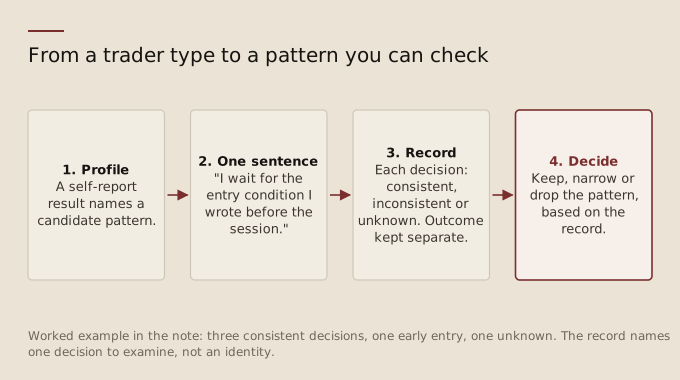
Copy this observation exercise
Choose one sentence from a profile or from your own self-description. Translate it into a behaviour with a visible condition. For example: “I wait for the entry condition I wrote before the session.” Use your existing plan; do not loosen a risk limit to make a label fit.
Before observing, define which decision points you will record and how you will recognise them. Include planned waiting when it applies. If the session offers no eligible points, record none. Do not manufacture trades to fill the page.
For each point, copy this line into your notes: Time and context / written condition / evidence available then / action taken / consistent, inconsistent or unknown / outcome recorded separately / question to investigate. Screenshots or replay timestamps can make the record easier to revisit. Mark retrospective notes as retrospective.
Review the record for both supporting and conflicting examples. If your proposed pattern is entering early after a missed move, an early entry without a missed move challenges that explanation. Consistently waiting after missed moves challenges it too. Missing evidence stays unknown.
Choose a review window before starting so you do not stop the exercise at the first flattering example. The window is a practical choice, not a scientific threshold. You can use replay or simulation throughout. This is a TIP-designed observation aid, not a tested treatment or a promise of better returns.
When the profile and the record disagree
Keep the disagreement. You may have interpreted the question differently, remembered an unusual session, changed your process or observed a context the questionnaire did not capture. The record itself may also be incomplete. Check those possibilities before replacing one confident label with another.
If the rule was too vague to classify, clarify the observation before drawing a conclusion. If the rule was followed but results were poor, examine the strategy, costs and market conditions separately. If the rule was clear and repeatedly broken, the next investigation is the specific decision context. Our note on following a trading plan explores that question further.
Start with a provisional profile
The Free Trader Profile uses 18 self-report questions and takes about two minutes. Use the pattern your answers suggest as a starting question, then check it against your own decisions. It does not measure trading skill or predict returns.
Get My Free Trader Profile →Go further with the Full TIP Report. Complete the free Full Assessment to unlock your personalised report: 40+ pages connecting your self-reported patterns with questions to check against your trading records. $79 one-time, with a 14-day money-back guarantee. Start your profile and explore the full report →
Receive Field Notes by email. At the end of your free profile, save your result by email and select the separate, optional Field Notes checkbox. Unsubscribe anytime. Get your profile and choose email updates →
One useful next step
Pick one profile description and write the condition that would support or challenge the description. Then record the next eligible decision in replay or within your existing process. The useful output is a more precise question and a visible record, even if the original label turns out not to fit.
The researchers are not affiliated with TIP and do not endorse it. The worked example and observation exercise are TIP editorial proposals, not findings from the study.