
Willpower alone rarely fixes a trading mistake, because "discipline" names the symptom, not the cause. A broken rule often comes from one of three problems: fatigue late in a session (a resource problem), a system that does not fit how you work (a mismatch problem), or a rule left vague (a planning problem). Each one needs a different fix.
Moved your stop? Discipline problem. Revenge traded after a loss? Discipline.
Took profits too early? Discipline. Did not follow your plan? Discipline.
It is the one-word diagnosis that sounds right every time. That is exactly the problem. When the answer is always discipline, you never look deeper. You never ask why the breakdown happened, what triggered it, or whether the plan was built for the brain you are trading with.
Why does "more discipline" not fix a trading mistake?
"More discipline" does not fix a trading mistake because it names the symptom and stops the analysis. Discipline is not wrong. Discipline matters. But it has become a thought-terminating label. You slap it on a mistake and the analysis stops. The journal entry reads "need more discipline," you move on feeling like you learned something, and what you actually did was name the symptom and call it a diagnosis.
Try this. Go back through your last ten journal entries where you wrote some version of "I was not disciplined." For each one, ask what was actually happening in that moment.
Were you tired? Were you already down on the day and trying to get back to even? Were you bored and forcing a trade because the market was slow? Were you in a setup you did not fully trust but took anyway because you felt like you should be trading?
Each of those is a different problem with a different fix. "More discipline" cannot distinguish between them. It bundles them and tells you to try harder, which is the least useful instruction a person can give themselves.
Which three problems look like a discipline failure?
Three problems look like a discipline failure from the inside: a resource problem, a mismatch problem and a planning problem.
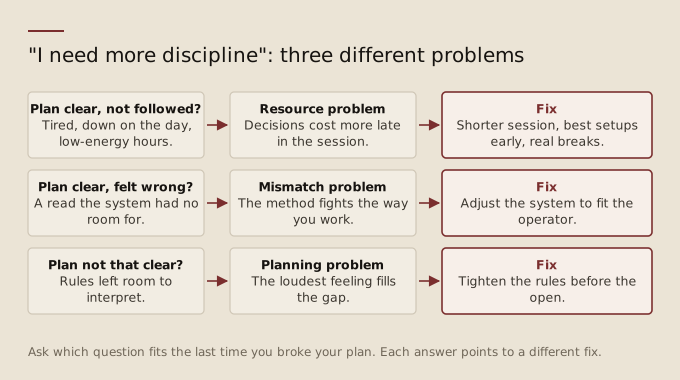
The resource problem. Decision quality degrades across a session. This is the plainest observation in trading and every trader has felt it: the last hour is not the same brain as the first. Roy Baumeister's ego-depletion work (1998) proposed a mechanism for it, a finite self-control resource that drains with use. Worth knowing that the magnitude has been contested since: a large multi-lab replication in 2016 failed to reproduce the effect at the size originally reported, and the debate is unresolved. We are not going to pretend otherwise to make a cleaner story.
What is not in dispute is the practical shape. Fatigue changes decisions. So when a trader says "I lost discipline in the afternoon," the useful translation is: by 1pm my decisions got more expensive and I started defaulting to instinct instead of the plan.
The fix is not "be more disciplined in the afternoon." It is a shorter session, or front-loading your highest-conviction setups into the first two hours, or a real break at midday instead of watching charts while eating lunch, or fewer open positions so each decision costs less. Structural fixes. They require less willpower, not more.
The mismatch problem. Your system might simply not fit the way you process.
If you read the market visually and structurally but you are forcing yourself to trade a spreadsheet-driven statistical edge, you will "break discipline" constantly. Not because you are weak. Because the method may be fighting the way you work, every session.
If you need to understand why before you commit, and your system says "just take the signal," you will hesitate. You will skip entries, second-guess triggers, then watch the trade work without you. The journal says lack of discipline. What may have happened is that your system asked you to switch off the part of your mind that keeps you out of trouble, and it refused.
The planning problem. A lot of discipline failures are planning failures. If your rules leave room for interpretation in the moment, your mind fills that gap with whatever feeling is loudest. That is not indiscipline. That is ambiguity, and you built it in before the session started.
How do you tell which problem you have?
Ask three questions about the last time you broke your plan:
Was the plan clear, and I just did not follow it? Look at the context. Fatigued, emotional, trading during a low-energy part of your day? That is resource management.
Was the plan clear, but something felt wrong in the moment? That may be a genuine read your system had no room to express. Overriding it costs enormous willpower, and sometimes the read is right.
Was the plan actually not that clear? Then tighten the rules before the session, not during it.
Each answer points somewhere different. Resource management means redesigning the session. A mismatch means adjusting the system to fit the operator, or changing the operator's role in it. Ambiguity means the work happens before the open.
Stop guessing which one it is
Resource problem, mismatch problem, planning problem: they feel identical from the inside and have completely different fixes. The Free Trader Profile names your closest archetype and the failure mode worth checking against your own journal. Two minutes, no account.
Get My Free Trader Profile →Go further with the Full TIP Report. Complete the free Full Assessment to unlock your personalised report: 40+ pages connecting your self-reported patterns with questions to check against your trading records. $79 one-time, with a 14-day money-back guarantee. Start your profile and explore the full report →
Receive Field Notes by email. At the end of your free profile, save your result by email and select the separate, optional Field Notes checkbox. Unsubscribe anytime. Get your profile and choose email updates →
What to do with this
Next time you catch yourself writing "I need more discipline," stop. Write three sentences about what was actually happening. What was your energy level? What had happened in the session before that trade? What specifically felt hard about executing?
Patterns will surface. Not "I lack discipline" but "I break down after my third consecutive loss," or "I force trades when the first hour is slow," or "I cannot hold through pullbacks on setups I entered late."
Those are specific enough to fix. More discipline is not.
Hagger, M. S., et al. (2016). A multilab preregistered replication of the ego-depletion effect. Perspectives on Psychological Science, 11(4), 546 to 573.
The researchers cited here are not affiliated with TIP and do not endorse it. We cite their published findings; the application is our own.